
Each week until Election Day, The Caucus ranks the Republican-held Senate seats Democrats are most likely to flip. Republicans hold 53 seats, so Democrats need to net four for the majority.
Nothing switched places this week. The top eight sit in the order they held last week, and South Carolina joins at ninth after we moved it out of the safe column yesterday.
Both stopped spending in North Carolina, meaning the seat could move to safer territory in our ratings soon. The Democrats’ Senate Majority PAC pulled its remaining reservations there on Oct. 12 and sent $7 million of it to Ohio and $2.5 million to Iowa. The GOP’s Senate Leadership Fund stopped spending in the state at the start of the month and has since committed $5 million to South Carolina. With three weeks left, the committees are showing which seats they think are actually still in play.
Third-quarter reports are due at the Federal Election Commission on Thursday. Two candidates on this list have released a number ahead of the deadline. For the rest, what follows is about spending.
Here is Week 5, three weeks out:
| CAUCUS+ SENATE TOP 9 · WEEK 5 · 3 WEEKS OUT | ||
1 | North Carolina Roy Cooper vs. Michael Whatley · open | D Advantage |
2 | Alaska Mary Peltola vs. Dan Sullivan | Toss up |
3 | Maine Troy Jackson vs. Susan Collins | Toss up |
4 | Ohio Sherrod Brown vs. Jon Husted · special | Toss up |
5 | Texas James Talarico vs. Ken Paxton | Toss up |
6 | Iowa Josh Turek vs. Ashley Hinson · open | Toss up |
7 | Kansas Adam Hamilton vs. Roger Marshall | R Advantage |
8 | Florida Angie Nixon vs. Ashley Moody · special | Expected R |
9 NEW | South Carolina Annie Andrews vs. Darline Graham · appointed | Expected R |
| South Carolina joins the list. No other seat moved. | ||
1. North Carolina stays first, and it is nearly finished. Former Republican National Committee Chairman Michael Whatley's campaign had $65,000 of television booked for the week of Oct. 8 and nothing after it, according to AdImpact. Roy Cooper bought close to $2 million that week and holds $7.3 million in reservations through Election Day. The GOP’s Senate Leadership Fund has spent about $30 million of the $71 million it pledged and is moving the rest to other states. The Democratic side followed on Oct. 12. Retiring GOP Sen. Thom Tillis endorsed Whatley on Oct. 8, his first endorsement of the cycle, and used the same interview to say Whatley should not appear with Trump.
2. Alaska stays second. Mary Peltola's campaign said Tuesday that she raised about $17 million in the third quarter, which it called a record third quarter for any Alaska Senate candidate. The last time both candidates' balances were public, on July 29, Sen. Dan Sullivan had $7.3 million on hand and Peltola had $4.6 million. She spent about 95 cents of every dollar she took in during the second quarter. Seventeen million dollars is a big number in a state with only one House district, and Thursday's filing will show how much of it is left for the final push. Sullivan went up with $1 million in new advertising this week, Senate Majority PAC announced $3.5 million against him, and Trump rallied for him in Wasilla the same day.
3. Maine stays third. Barack Obama endorsed Troy Jackson on Oct. 8 via video, hours before Jackson and Sen. Susan Collins met for their second debate. They debated again yesterday, and a fourth joint appearance follows tomorrow. The week also produced the strangest line item of the cycle: Defending Main Street, a super PAC tied to the Republican Main Street Partnership, spent $20,000 to $25,000 running an anti-Jackson ad in Portland, Ore., instead of the one in Maine, from Oct. 8 to Oct. 11.
4. Ohio stays fourth, and it is where the North Carolina money went. Senate Majority PAC added $7 million on Oct. 12, taking its Ohio commitment to try to get former Sen. Sherrod Brown back to Washington to $70 million. About $250 million has been spent in the state through September, with roughly $140 million more reserved for the closing weeks. Trump rallied for Sen. Jon Husted in Youngstown on Monday, and Vice President JD Vance did the same in Lima a few days before. Americans for Prosperity says it has knocked more than 700,000 doors for Husted. The number to watch is the early vote. More than 120,000 Ohioans had cast ballots by Oct. 9, and a CNN analysis found that in counties Trump carried by 20 points or more in 2024, the Republican edge among early voters has narrowed from about 30 points at this stage two years ago to roughly five.
5. Texas stays fifth. Ken Paxton announced more than $18 million for the quarter, his best-ever result, and his campaign claimed more than 160,000 unique donors. The newly found fundraising success aside, Paxton has still not agreed to debate Democrat James Talarico — who has accepted four invitations and says Paxton has not answered the request in 85 days. In more bad news for Paxton, The Wall Street Journal reported this week that he spent New Year's Eve 2024 at a party in Dubai with two American fugitives, one of whom had given his campaign $190,000. Early voting begins Oct. 19.
6. Iowa stays sixth. Senate Majority PAC put in another $2.5 million on Oct. 12 (also funded by the North Carolina pullout), bringing its Iowa total to $32.5 million to support Democrat Josh Turek. Turek and U.S. Rep. Ashley Hinson debated on Iowa PBS last week and met again yesterday for the last time.
7. Kansas stays seventh and keeps getting more expensive. Senate Majority PAC committed $5 million to a statewide run beginning Oct. 10 and lasting through Election Day, the first serious Democratic television in the state. Trump promised a "Kansas Style rally very soon," without naming a date or a city, and the state party could not confirm one. Adam Hamilton went on ABC News on Oct. 11 to answer Vance's attacks on his faith, calling them "sad" and "pathetic."
8. Florida holds at eighth, and not much in the race changed. Sen. Bernie Sanders (D-VT) is holding four events with Angie Nixon over the weekend, and his political committee gave her campaign $250,000. Sen. Chris Murphy (D-CT) is in Orlando today, and Rep. Ro Khanna (CA-17) follows on Oct. 20.
9. South Carolina is new to the list. The GOP’s Senate Leadership Fund pledged $5 million here on Oct. 6, a week after we had the seat in the safe column. Sen. Tim Scott (R-SC), who chairs the National Republican Senatorial Committee, campaigned with appointed Sen. Darline Graham on Oct. 9 and said South Carolina is not among the committee's 10 toss-up states and that "we are not having to use outside resources in South Carolina." Those two facts are difficult to hold at the same time. Democrat Annie Andrews and Graham held the only debate of the race on Saturday.
One seat we left off. We moved Nebraska from Expected R to R Advantage yesterday, and it is still not on the list because Dan Osborn is running as an independent and has not said which party he would caucus with. Republicans losing that seat would not automatically put a Democrat in it, though it’s all-but certain Osborn would side with the Democratic Caucus more then the Republicans. The race itself is live. Outside spending has passed $15 million and is close to even, $7.9 million against Osborn and $7.3 million against Sen. Pete Ricketts through Oct. 1, and most of it comes from two super PACs formed this year that spend in no other race and list post office boxes as their addresses. National Security Leaders for America, a group of 1,600 retired defense officials, endorsed Osborn in Papillion, Neb., last week.
And here are the Democratic-held seats that are not completely safe:
| SEATS DEMOCRATS ARE DEFENDING | ||
1 | Michigan Abdul El-Sayed vs. Mike Rogers · open | Toss up |
2 | New Hampshire Chris Pappas vs. John E. Sununu · open | D Advantage |
3 | Minnesota Peggy Flanagan vs. Michele Tafoya · open | Expected D |
4 | Georgia Jon Ossoff vs. Mike Collins | Expected D |
| Ranked by risk of loss. New Hampshire moves to D Advantage, so Michigan is now the closest of the four. Democrats need all four plus a net four pickups for 51. | ||
Michigan is the seat we would worry about, and it is first here now because New Hampshire improved. The American Israel Public Affairs Committee's United Democracy Project, which spent $33 million against Abdul El-Sayed in the primary, re-entered the race with a single mail buy of $94,620 aimed at 130,000 Jewish voters. That was the day after former GOP Rep. Mike Rogers said at their first debate that "anybody that wants to help my campaign, I'll take all of that help." Republicans have outspent Democrats on air in Michigan, $78 million to $63 million, and about $40 million of the Republican total has gone to negative advertising.
New Hampshire moved to D Advantage on our board yesterday. Rep. Chris Pappas (NH-01) spent the week with surrogates, including Sen. Raphael Warnock (D-GA), former U.S. Secretary of Transportation Pete Buttigieg, Sen. Maggie Hassan (D-NH) and Sen. Andy Kim (D-NJ). Former GOP Sen. John Sununu is running a self-deprecating spot in which he pretends to swear, a response to several million dollars of advertising calling him corrupt.
Minnesota has gone quiet. Outside spending in the general election is around $2 million, after more than $20 million in the primary. Sen. John Thune, the GOP leader, declined to commit Senate Leadership Fund money when asked alongside Republican nominee Michele Tafoya. Former Secretary of State Hillary Clinton endorsed Democratic nominee Lt. Gov. Peggy Flanagan, her first Senate endorsement of the cycle. The only debate is Friday.
Georgia holds. Sen. Jon Ossoff and Rep. Mike Collins debated last week and again yesterday. Obama cut an ad for Ossoff. Early voting opened Tuesday and runs through Oct. 30. Trump rallies in Dalton on Friday.
And this is how The Caucus sees the whole Senate map:
| SENATE RATINGS SUMMARY · DEMOCRATS NEED 51 | |||||
| CATEGORY | SEATS | D TOTAL | |||
| Safe D | 9 | 43 | |||
| Expected D | 2 | 45 | |||
| D Advantage | 2 | 47 | |||
| Toss up | 6 | ||||
| R Advantage | 2 | ||||
| Expected R | 2 | ||||
| Safe R | 12 | ||||
| No election 34 D, 31 R | 65 | ||||
HELD NOW 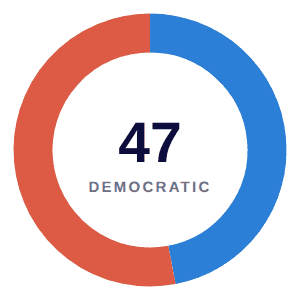 47 Democratic 53 Republican | |||||
| Democrats reach 47 without the toss ups, which is where they sit now, and 53 with all of them. | |||||