
Each week until Election Day, The Caucus is ranking the eight Republican-held Senate seats Democrats are most likely to flip. Republicans hold 53 seats, so Democrats need to net four for the majority.
Texas and Iowa traded places this week. We didn’t move any other states, and none of our ratings in these eight seats changed.
We are also adding a second chart below, covering the four Democratic-held seats that aren’t completely safe. Two of them moved this week, which we wrote about here.
Here is Week 3, five weeks out:
| CAUCUS+ SENATE TOP 8 · WEEK 3 · 5 WEEKS OUT | ||
1 | North Carolina Roy Cooper vs. Michael Whatley · open | D Advantage |
2 | Alaska Mary Peltola vs. Dan Sullivan | Toss up |
3 | Maine Troy Jackson vs. Susan Collins | Toss up |
4 | Ohio Sherrod Brown vs. Jon Husted · special | Toss up |
5 ▲1 | Texas James Talarico vs. Ken Paxton | Toss up |
6 ▼1 | Iowa Josh Turek vs. Ashley Hinson · open | Toss up |
7 | Florida Angie Nixon vs. Ashley Moody · special | Expected R |
8 | Kansas Adam Hamilton vs. Roger Marshall | Expected R |
| ▲ toward a Democratic flip, ▼ away. | ||
North Carolina stays first and is still the only one of the eight we rate D Advantage. Semafor reported on Sept. 17 that Senate Republicans are weighing whether to keep funding this race and Georgia’s, with Republican Sen. John Cornyn saying on the record that “Georgia looks like it’s pretty close to done. And North Carolina seems to be close to that.” GOP Sen. Tim Scott, the chairman of the National Republican Senatorial Committee, pushed back six days later and said Republicans are still in it.
Maine stays third on our list. Sen. Susan Collins has been on a statewide Maine ballot since 1994 and won this seat in 1996, and voters in the latest New York Times/Press Herald/Siena survey picked her over Jackson 59-35 on the ability to bring resources to the state. Jackson’s side of that argument isn’t visible yet. He became the Democratic nominee at a party convention on July 25, after Graham Platner suspended his campaign, and his committee will file its first report after the Sept. 30 deadline (due to be disclosed on Oct. 15). That will tell us more about this race than anything else between now and then.
Ohio stays fourth. Fairshake, the crypto industry’s super PAC, has pledged $30 million to beat former Sen. Sherrod Brown again, its largest single-candidate commitment this cycle. An affiliated group disclosed $11.4 million in media on Sept. 24 supporting Sen. Jon Husted and opposing Brown. The same network spent roughly $40 million in 2024 to beat Brown and elect Bernie Moreno, who won by 3.6 points on the same ballot Trump carried by 11. The NRSC has added $11.2 million, the largest state figure in the $46.5 million coordinated program it described to Axios. Brown has led every public poll released since late July, but that was before this onslaught of outside money begins.
Texas moves up a spot. Democrat James Talarico has raised $68.6 million into his campaign committee and spent $47 million of it. Paxton has raised just $9.2 million. Both are running for a seat GOP Sen. John Cornyn still holds (he was the first Texas senator denied renomination since 1970). Texas Forever, a new super PAC affiliated with Senate Majority PAC, filed with the FEC on Sept. 24, which is the first public sign that Senate Democratic leadership plans to spend there. AdImpact puts the race at $153 million in ad spending already and projects $440 million by Election Day, roughly double the state record of $210 million that Ted Cruz and Colin Allred set in 2024.
Iowa slipped a spot in our rankings, though it wasn’t about what is happening in the state. The NRSC has committed $8.8 million, the second-largest figure in that eight-state program, and Republicans are treating the seat as a real contest. Texas passed Iowa because the arrival of Senate Majority PAC gives that race a new floor that Iowa doesn’t really have yet.
And here are the Democratic-held seats that aren’t completely safe:
| SEATS DEMOCRATS ARE DEFENDING | ||
1 | New Hampshire Chris Pappas vs. John E. Sununu · open | Toss up |
2 | Michigan Abdul El-Sayed vs. Mike Rogers · open | Toss up |
3 | Minnesota Peggy Flanagan vs. Michele Tafoya · open | Expected D |
4 | Georgia Jon Ossoff vs. Mike Collins | Expected D |
| Ranked by risk of loss. Democrats need to hold all four and net four pickups for 51. | ||
Michigan has drawn more committed outside money than any other seat Democrats are defending. Senate Majority PAC is in for $30 million, adding $10 million of it on Sept. 16. Senate Leadership Fund has committed $51 million to the state and spent $6 million of that on an August run of ads against Democrat Abdul El-Sayed. Elon Musk’s America PAC put about $1 million behind Republican Mike Rogers this month. Rogers lost to now-Sen. Elissa Slotkin by three tenths of a point in 2024 and is running again with more outside help than he had then. El-Sayed’s line is that all pathways to a Senate majority run through Michigan, and both parties are spending like they agree.
Georgia moved up to Expected D in our ratings this week because real Republican money still isn’t headed to the state. Senate Leadership Fund and One Nation pledged close to $60 million against Sen. Jon Ossoff and only a fraction of it has materialized. A recent $2.1 million buy is what Mike Collins’s allies now point to as proof the race is still in play, and about $500,000 in reservations was canceled, which the group called routine rebalancing. When the NRSC announced its eight-state program, Georgia made the list with no dollar figure attached, while Ohio got $11.2 million and Iowa $8.8 million. Ossoff had $42 million in the bank on June 30 against Collins's $2.2 million.
And this is how The Caucus sees the whole Senate map:
| SENATE RATINGS SUMMARY · DEMOCRATS NEED 51 | |||||
| CATEGORY | SEATS | D TOTAL | |||
| Safe D | 9 | 43 | |||
| Expected D | 2 | 45 | |||
| D Advantage | 1 | 46 | |||
| Toss up | 7 | ||||
| R Advantage | |||||
| Expected R | 3 | ||||
| Safe R | 13 | ||||
| No election 34 D, 31 R | 65 | ||||
HELD NOW 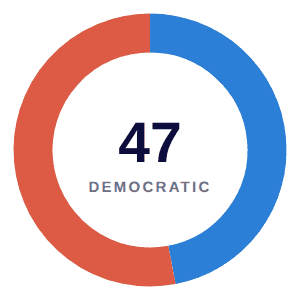 47 Democratic 53 Republican | |||||
| Democrats reach 46 without the toss ups and 53 with all of them. | |||||
(Photo: Troy Jackson, via Troy Jackson for Senate Facebook)