
Each week until Election Day, The Caucus is ranking the Republican-held Senate seats Democrats are most likely to flip. Republicans hold 53 seats, so Democrats need to net four for the majority.
Kansas and Florida traded places this week, and we moved Kansas from Expected R to R Advantage. We didn't move any other states.
Here is Week 4, as we’re four weeks out:
| CAUCUS+ SENATE TOP 8 · WEEK 4 · 4 WEEKS OUT | ||
1 | North Carolina Roy Cooper vs. Michael Whatley · open | D Advantage |
2 | Alaska Mary Peltola vs. Dan Sullivan | Toss up |
3 | Maine Troy Jackson vs. Susan Collins | Toss up |
4 | Ohio Sherrod Brown vs. Jon Husted · special | Toss up |
5 | Texas James Talarico vs. Ken Paxton | Toss up |
6 | Iowa Josh Turek vs. Ashley Hinson · open | Toss up |
7 ▲1 | Kansas Adam Hamilton vs. Roger Marshall | R Advantage |
8 ▼1 | Florida Angie Nixon vs. Ashley Moody · special | Expected R |
| ▲ toward a Democratic flip, ▼ away. | ||
North Carolina stays first. The GOP's Senate Leadership Fund had $18 million booked in the state for the next month and is pulling it back, after spending about $32 million there already, and that money is going to Kansas. Semafor reported that Senate Republicans were weighing whether to keep funding the race, with Sen. John Cornyn saying North Carolina "seems to be close to" done. Sen. Tim Scott pushed back six days later and said Republicans were still in it. The reservations are the first hard number on that question. Republican Michael Whatley's campaign says it has the resources it needs, and Trump carried the state by just over three points in 2024, but former Gov. Roy Cooper is the clear and obvious favorite here.
Alaska stays second. The public surveys here ran from a seven-point former Rep. Mary Peltola lead to a one-point Sen. Dan Sullivan lead inside the same week, so we're waiting on something more durable than polling before we move it.
Maine stays third. Sen. Susan Collins has been on a statewide ballot in Maine since 1994, so everyone in the state already knows her. Troy Jackson, on the other hand, became the Democratic nominee at a party convention on July 25. His first FEC report covers July through September and gets disclosed Oct. 15. That filing is the thing to watch, along with the two debates he and Collins hold this week.
Ohio stays fourth. Fairshake, the crypto industry's super PAC, has pledged $30 million to beat former Sen. Sherrod Brown again, and an affiliated group disclosed $11.4 million late last month supporting Sen. Jon Husted. The same network spent roughly $40 million in 2024 to beat Brown and elect now-Sen. Bernie Moreno, who won by 3.6 points on a ballot Trump carried by 11. The NRSC has added $11.2 million, the largest state figure in its $46.5 million program. Brown has led every public poll since late July, but most of that money still hasn't reached the air.
Texas stays fifth. James Talarico's campaign has raised $68.6 million to Ken Paxton's $9.2 million, and AdImpact now projects $440 million in ad spending in this race by Election Day, roughly double the $210 million state record Sen. Ted Cruz and then-Rep. Colin Allred set in 2024. We didn't move the race up because more money went on the GOP side. The Texas Tribune reported that Republican outside spending has given Paxton the overall advantage despite that gap in what the two campaigns themselves have raised. Texas hasn't elected a Democrat statewide since 1994.
Iowa stays sixth. The NRSC has committed $8.8 million here, the second-largest figure in its eight-state program, and Republicans are still treating the seat as a real contest. Rep. Ashley Hinson and Josh Turek debate today at 7pm in Iowa (8pm ET).
Kansas moves up a spot, and we also moved its rating from Expected R to R Advantage, an improvement for the Democrats. Senate Leadership Fund reserved nearly $8.2 million in the state for the next month. Republican Sen. Roger Marshall's campaign booked another $2.3 million and other groups added $500,000. Democrat Adam Hamilton, who leads the largest United Methodist church in the country, has reserved $590,000 with about $556,000 in outside support behind him.
Republicans weren't planning to spend any real money here. Marshall won this seat by more than 11 points in 2020 and Trump carried Kansas by nearly 16 in 2024. Two former Republican governors of the state have endorsed Hamilton, Bill Graves on Sept. 23 and Mike Hayden on Oct. 2, and state Democratic chair Jeanna Repass tied the change in the electorate’s mood to diesel prices and the war in Iran. Public polling now has the race about even.
We kept Kansas behind Iowa because Hamilton has to beat a sitting senator rather than win an open seat, and because that $11 million hasn't gone up on the air yet.
Florida drops to eighth, which is more about Kansas than about Florida. Almost no independent expenditure has shown up in this race in either direction, and State Rep. Angie Nixon is counting on small-dollar money and a ground game against Sen. Ashley Moody. Nothing in the last week changed that.
And here are the Democratic-held seats that aren't completely safe:
| SEATS DEMOCRATS ARE DEFENDING | ||
1 | New Hampshire Chris Pappas vs. John E. Sununu · open | Toss up |
2 | Michigan Abdul El-Sayed vs. Mike Rogers · open | Toss up |
3 | Minnesota Peggy Flanagan vs. Michele Tafoya · open | Expected D |
4 | Georgia Jon Ossoff vs. Mike Collins | Expected D |
| Ranked by risk of loss. Democrats need to hold all four and net four pickups for 51. | ||
Michigan is still second on this list. Dr. Abdul El-Sayed and former Rep. Mike Rogers debate Thursday at 7pm ET, their first meeting of the race. Rogers lost to now-Sen. Elissa Slotkin by three tenths of a point in 2024 and is running again with more outside help than he had then, and the Democrats' Senate Majority PAC has committed $30 million here against the GOP's Senate Leadership Fund's $51 million.
Georgia holds at Expected D. Sen. Jon Ossoff has raised more than $81 million, almost 20 times what Rep. Mike Collins has raised, and the two debate Thursday at 7pm ET. It's the one race among this week's six debates that we no longer rate competitive.
And this is how The Caucus sees the whole Senate map:
| SENATE RATINGS SUMMARY · DEMOCRATS NEED 51 | |||||
| CATEGORY | SEATS | D TOTAL | |||
| Safe D | 9 | 43 | |||
| Expected D | 2 | 45 | |||
| D Advantage | 1 | 46 | |||
| Toss up | 7 | ||||
| R Advantage | 1 | ||||
| Expected R | 2 | ||||
| Safe R | 13 | ||||
| No election 34 D, 31 R | 65 | ||||
HELD NOW 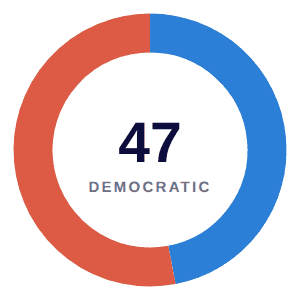 47 Democratic 53 Republican | |||||
| Democrats reach 46 without the toss ups and 53 with all of them. | |||||
(Photo: Adam Hamilton, via Adam Hamilton for Kansas Facebook)